I have found this week's lectures and reading very interesting. I thought the reading was really interesting and I enjoyed it more than previous readings. I thought it was interesting for a few reasons. First, I found it was easier to relate to than other readings. Of course, I'm not a soldier and I will never know what it is like to be in war, but it is about something that is still going on and we have been around to experience. We have learned about WWII and the Vietnam War, but we could not relate to the Herr and Pyle readings as much because it was before our time. Also what was different about this story, is that is was written by a soldier, not a journalist. I don't want to go into too much detail about comparing the readings because it's a final exam question, but of course I found it interesting just because of the difference in tone of the stories, as well as the difference in the actual content.
Another thing I found interesting this week was the lecture yesterday about war memorials. I was not really familiar with any of the memorials so it was interesting seeing the pictures and hearing the stories of how they were designed and built. I was particularly interested in the Memorial to Women in Military Service. Although it didn't surprise me too much that once again women were discriminated against, through the design and building of the memorial. It, of course, made me a bit angry that even women who served for our country cannot get proper recognition. It is a shame that there isn't even a sign or plaque to recognize what the memorial is. Also, I wasn't even aware this memorial existed! I'm sure a lot of other people aren't familiar with it and that probably stems from the fact that it is barely on the mall, has no signs, and wasn't even paid for or supported by our government.
Thursday, April 16, 2009

Thursday, April 9, 2009
reflection 3
I found Professor Hass's lecture yesterday to be very interesting. I did not know that the Vietnam memorial brought about the public pastime of leaving items of sentimental value at places of tragedy. For American people who were mourning the loss of many soldiers, this was a method of recovery, just like the memorial represented American recovery. For some people, it feels good to leave an item that resembles the lost friend or relative. However, to me it shows how materialistic people can be. Americans feel the need to share a visual item with all who will look upon it. In this way, it makes it easier to express sorrow if other people acknowledge a person's feelings by thinking about the representational items left behind. Another thought I had about the memorial occurred when Professor Hass showed the picture where the Washington Monument was seen in the distance. She briefly suggested that it was obvious how the shape of the Washington Monument represented male masculinity while the Vietnam Memorial represented "not-so-male masculinity". I really don't think the artists had the idea of human anatomy consciously in mind when designing the monuments, but it is something to think about and argue over. The monuments are representational but are also art and the perception of their exact meaning is in the eye of the individual.
Wednesday, April 8, 2009
Reflection 3
I found today’s lecture on the Vietnam Memorial to be very insightful, especially concerning memorial gifts that were brought in honor of the soldiers who served and died in the war. Growing up my parents always encouraged me to bring an object to a funeral that reminded me of the deceased, such as a photograph. When I was young I figured the act of bringing these objects was just a normal tradition or ritual that had been passed down for many generations. Learning that this new traditions started just a couple decades ago came as a shock.
I also found it very fascinating knowing how the ideas and feelings toward soldiers have changed dramatically during the course of our history. At the very beginning of our early nation and in other countries, soldiers were buried in mass graves and not identified. The battle at Gettysburg changed this custom by placing soldiers into individual graves and attempted to identify the bodies. What I find most interesting and which makes me proud is that we have continued to put emphasis on the soldier. We later gave dog tags to soldiers after Gettysburg. During the Vietnam War, Americans put the emphasis on the soldier greatly and organizations such as POW were created to help combatants. What I find most interesting is how we have gone from a nation where we placed our soldiers into mass graves, to a nation that spends millions of dollars searching for the bodies of soldiers that may have been lost. This nation transition has placed the soldier in the center of the war which continues today and will continue in future wars.
I also found it very fascinating knowing how the ideas and feelings toward soldiers have changed dramatically during the course of our history. At the very beginning of our early nation and in other countries, soldiers were buried in mass graves and not identified. The battle at Gettysburg changed this custom by placing soldiers into individual graves and attempted to identify the bodies. What I find most interesting and which makes me proud is that we have continued to put emphasis on the soldier. We later gave dog tags to soldiers after Gettysburg. During the Vietnam War, Americans put the emphasis on the soldier greatly and organizations such as POW were created to help combatants. What I find most interesting is how we have gone from a nation where we placed our soldiers into mass graves, to a nation that spends millions of dollars searching for the bodies of soldiers that may have been lost. This nation transition has placed the soldier in the center of the war which continues today and will continue in future wars.
Before today's lecture I hadn't really ever thought about national monuments/memorials, even though it was brought up several times before by Professor Hass in lecture. The Vietnam Memorial sticks out the most to me though, because it was very different from the previously discussed ones (Washington and Lincoln memorials). It was interesting to me to see the how Teddy Roosevelt's take on manliness and the nation has carried through in U.S. history. The fact that Reagan rejected the design of the Vietnam Memorial because it was not manly or herioc enough reemphasizes the nation's desire to appear strong and powerful. This recurring themes makes me wonder how our recent presidents have encouraged this very vision. Is this need to show manliness still dominant today?
Before this lecture, I also never thought about the practice of bringing stuff to sites of tragedy or memory. I attributed this practice as a way for the people to honor the memory of the life lost, that physically bringing something tangible to the deceased person (or place of memory for the deceased person) is a way to invoke the memory and the life of that loved one. There seems to be a need to bridge the gap between what no longer physically exists and what is still physically there. Bringing stuff to to a memorial could be a way to narrow that gap. It seems that leaving one things at a memorial is both a way of remember a person whose life was cut short and a way to help them themselves move on.
Before this lecture, I also never thought about the practice of bringing stuff to sites of tragedy or memory. I attributed this practice as a way for the people to honor the memory of the life lost, that physically bringing something tangible to the deceased person (or place of memory for the deceased person) is a way to invoke the memory and the life of that loved one. There seems to be a need to bridge the gap between what no longer physically exists and what is still physically there. Bringing stuff to to a memorial could be a way to narrow that gap. It seems that leaving one things at a memorial is both a way of remember a person whose life was cut short and a way to help them themselves move on.
Monday, April 6, 2009
I also found today's lecture to be very informative and interesting. However, in contrast to Alex's feelings coming out of lecture, I found the "disasters" of the 1970's made me feel more reassured during our troubling times we are experiencing now as a country. If we were able to survive supply shocks and disasters to many of the important institutions and sphere's of American life in the 1970's we may be able to emerge as a stronger America in the near future. Among some of the more troubling similarities between the 70's and now would be the current account deficit (which has only seemed to grow), the % of American oil that is imported (and the similar political and social instability of the OPEC nations), a disastrous war that was not well received at home and abroad, an environmental crisis, and the real perception of lack of transparency and accountability among the executive branch of government.
I thought the interesting part of lecture came in the discussion of former President Jimmy Carter. From what I knew about Presidents going into lecture, it was said of Jimmy C that he was a very smart man, but a notorious micro-manager who was not able to get anything done because of it. I am divided whether or not to sympathize with his pragmatic and parental approach of telling America to suck it up with his sweater comment, or whether or not to be appalled at some of the ideas that were coming out of Washington in the day.
Reflection #4
I found today’s lecture to be a little disturbing. The expression “history always repeats itself” has never seemed as real to me as it did today. It seemed as though after every point Professor Hass made, she asked us “seem familiar?” The “disasters” of the 1970’s and those of the present time are nauseatingly similar. We are making the same mistakes we made almost forty years ago, and facing the same consequences we suffered through.
The best example of this from lecture, was when Professor Hass pointed out that our reliance on foreign oil is going in the wrong direction. In the 1970’s 35% of our oil came from foreign sources, leading to an oil crisis. What do we expect to happen now that we’ve reached a 55% reliance? It seems as though President’s Carter solution for wearing a sweater might not be as ridiculous as once perceived. Perhaps with practical solutions, we can begin to force our reliance on foreign oil in the right direction.
The events in Iraq and Vietnam are also shockingly parallel. With only the difference of a military draft, both wars are practically the same. Both were started under false pretenses. Both have received harsh ridicule from the American people. And both will be remembered as lapses in judgment on the part of the executive branch. Although corruption today is a common characteristic of an ambitious politician, have we learned nothing from Nixon and the Watergate scandal? It seems as though a solution to our current situation is to look to the 1970’s and recognize it as a decade of mistakes, mistakes that should not be repeated.
The best example of this from lecture, was when Professor Hass pointed out that our reliance on foreign oil is going in the wrong direction. In the 1970’s 35% of our oil came from foreign sources, leading to an oil crisis. What do we expect to happen now that we’ve reached a 55% reliance? It seems as though President’s Carter solution for wearing a sweater might not be as ridiculous as once perceived. Perhaps with practical solutions, we can begin to force our reliance on foreign oil in the right direction.
The events in Iraq and Vietnam are also shockingly parallel. With only the difference of a military draft, both wars are practically the same. Both were started under false pretenses. Both have received harsh ridicule from the American people. And both will be remembered as lapses in judgment on the part of the executive branch. Although corruption today is a common characteristic of an ambitious politician, have we learned nothing from Nixon and the Watergate scandal? It seems as though a solution to our current situation is to look to the 1970’s and recognize it as a decade of mistakes, mistakes that should not be repeated.
response #3 cont...
after looking at it i wasnt quite sure if my last post was long enought so i wanted to add a littel bit more.
as were many other people, as evidence by the posts, i was very struck by the differences between Pyle and Herrs correspondences. i can remember even laught a couple of times during pyles article, for exampel, at the way he described the german prisoners of war looking out upon the allied invasion fleet. However, the only thing i remember about Herrs was cringing and even needing a little bit of a break for some comic relief. again, like many others i feel that this is indicative of the characreristic of the two wars. nobody really knew what was going on in vietnam and so this led to the fear and frustration so eloquently expressed by Herr; while in WWII the soldiers, especially by the time that Pyle was writing what we were reading, felt that there was little chance we would lose the war becuase we were taking part in a much more orgainsed war with a much clearer moral goal which led to much more relaxed/ adventuristic tone of Pyles writing. I hope that this makes sense.
as were many other people, as evidence by the posts, i was very struck by the differences between Pyle and Herrs correspondences. i can remember even laught a couple of times during pyles article, for exampel, at the way he described the german prisoners of war looking out upon the allied invasion fleet. However, the only thing i remember about Herrs was cringing and even needing a little bit of a break for some comic relief. again, like many others i feel that this is indicative of the characreristic of the two wars. nobody really knew what was going on in vietnam and so this led to the fear and frustration so eloquently expressed by Herr; while in WWII the soldiers, especially by the time that Pyle was writing what we were reading, felt that there was little chance we would lose the war becuase we were taking part in a much more orgainsed war with a much clearer moral goal which led to much more relaxed/ adventuristic tone of Pyles writing. I hope that this makes sense.
Response #3
Again, i must say that i have enjoyed our discussions. i may even had a new favorite part of american history. there were a few things that i thought were interesting about the topic weve been discussing lately.
first, i found the documentay that we watched on McNemara (Spelling?) very interesting. it is really erie to hear the way that they thought about vietnam back then. there was somthing that struck me more than anything else though. what i took from lecture was that in this documentary McNemara was basically saying...yeah, we made these mistakes, but even that is better than a full on war with the russians. while i cant say that i disagree with that assesment it begs a very important question. why did there have to be a war at all? how about we ust dont bomb the H#ll out of North Vietnam and dont have a war with North Vietnam or Russia.
Second, is the fact that the cold war was not menttioned untill the very last lecture on the war, and even then it was only relatively lightly mentioned. i am taking another Amcult class on the cold war and in that class vietnam was taught as still a very central part of the vietnam war. im not saying there is a problem with either class, just that it is an interesting comparison.
Finally, i am going to be presenting in section this week so i look forward to more grat discussion!
first, i found the documentay that we watched on McNemara (Spelling?) very interesting. it is really erie to hear the way that they thought about vietnam back then. there was somthing that struck me more than anything else though. what i took from lecture was that in this documentary McNemara was basically saying...yeah, we made these mistakes, but even that is better than a full on war with the russians. while i cant say that i disagree with that assesment it begs a very important question. why did there have to be a war at all? how about we ust dont bomb the H#ll out of North Vietnam and dont have a war with North Vietnam or Russia.
Second, is the fact that the cold war was not menttioned untill the very last lecture on the war, and even then it was only relatively lightly mentioned. i am taking another Amcult class on the cold war and in that class vietnam was taught as still a very central part of the vietnam war. im not saying there is a problem with either class, just that it is an interesting comparison.
Finally, i am going to be presenting in section this week so i look forward to more grat discussion!
Sunday, April 5, 2009
Reflection #4
I thought that the Herr article was very graphic and differed greatly from Pyle. There are so many factors that contributed to the differences in the styles of these two articles. During WWII we lost more men than in Vietnam, but the Vietnam War hit home harder because it received more coverage. Americans were able to see the horrors of the Vietnam War and were constantly surrounded by it, while WWII was not covered as much. Herr also used vivid details and specific experiences in his writing, while Pyle did not. He actually went into detail about soldiers being killed and what the corpses looked like.
We have talked in discussion about the idea of the two wars being different in terms of the patriotism expressed during these wars. After Pearl Harbor was attacked, the United Sates gained involvement in WWII. But with the Vietnam War there was no real danger that was threatening American citizens. This may be a reason why there was so much resentment and protest of the Vietnam War. Many Americans believed that we had no business even being their.
I believe that the causes of war relate to Herr and Pyle's accounts and experiences of the wars described in their articles. While Pyle expresses WWII in a lighter way and avoids gruesome details, Herr is much more graphic and pays close attention to details. America's outlook on WWII and the Vietnam War definitely influenced the way in which each war was interpreted. Herr's gruesome accounts were pushed by the antiwar sentiment of the time, while Pyle’s interpretation of WWII shows how blind and clueless Americans were.
We have talked in discussion about the idea of the two wars being different in terms of the patriotism expressed during these wars. After Pearl Harbor was attacked, the United Sates gained involvement in WWII. But with the Vietnam War there was no real danger that was threatening American citizens. This may be a reason why there was so much resentment and protest of the Vietnam War. Many Americans believed that we had no business even being their.
I believe that the causes of war relate to Herr and Pyle's accounts and experiences of the wars described in their articles. While Pyle expresses WWII in a lighter way and avoids gruesome details, Herr is much more graphic and pays close attention to details. America's outlook on WWII and the Vietnam War definitely influenced the way in which each war was interpreted. Herr's gruesome accounts were pushed by the antiwar sentiment of the time, while Pyle’s interpretation of WWII shows how blind and clueless Americans were.
Saturday, April 4, 2009
Reflection 2
Herr’s story of the Vietnam War brought to light many aspects of the war that I had very little knowledge about but what struck me most was how he described the war. His story not only enforced my belief that the war was horrific but his descriptions and narrative illustrates hell on earth. Every aspect of the war was brutal and harsh. The battles were sporadic and wicked. He describes that the soldiers and captains were always on the move because it was harder to hit a moving target. They also tried to be prepared for any situation that could occur but the irony was that with this constant movement, coupled with the cruelty of the forest, which Herr describes as almost alive, made it almost impossible to be prepared for everything and surprises happened frequently. Soldiers were also so exhausted from the war that it eventually got many of them killed.
What is horrific and what struck me the most was that this atmosphere was so terrible that it was almost guaranteed that all soldiers would “snap” at some point and go crazy. Herr describes an incident where a soldier placed a grenade on the door of an outhouse and it blew up once the next person used it. I think that these incidents occurred so frequently was because of the nature of the war itself. The constant carnage, the pure exhaustion and the constant moving would wear down anyone’s physical and mental strength. I enjoyed reading Herr’s article because he left nothing out and kept it raw, but that also made it hard to read knowing our soldiers had to go through it.
What is horrific and what struck me the most was that this atmosphere was so terrible that it was almost guaranteed that all soldiers would “snap” at some point and go crazy. Herr describes an incident where a soldier placed a grenade on the door of an outhouse and it blew up once the next person used it. I think that these incidents occurred so frequently was because of the nature of the war itself. The constant carnage, the pure exhaustion and the constant moving would wear down anyone’s physical and mental strength. I enjoyed reading Herr’s article because he left nothing out and kept it raw, but that also made it hard to read knowing our soldiers had to go through it.
Thursday, April 2, 2009
I found today's discussion both very interesting and informative. Vietnam is also talked about as a transformative topic and time in American history, and it is interesting to know about the reaction to the war domestically as well as other economic factors that ended up playing a large part in the overall scope of the war.
I think juxtaposing the Pyle reading from last week with Herr's article for today's discussion shows progression in American transparency in reporting that acted as a catalyst towards what it means to be an American. It was much easier to be an American during WWII when Pyle's writing (granted it was an editorial versus more fact based reporting) encouraged a greater public sentiment supporting the war, compared to the chaos and bloodshed captured in Herr's reporting. However, one could just as easily argue that public outrage and support for American involvement in WWII was much more unified and fervent due to the attack on American soil at pearl harbor, whereas the war in Vietnam was an abstract proxy war half a world away.
Reflection #3, The Vietnam War
After reading Herr's article and preparing the discussion on the material, I have gained a much better understanding of the feeling present in America at the time regarding the involvement in Vietnam. In the past, I have learned about the war, however never focused as much on the reaction of our people at home. I also had not thought of the economic factors that played a role in who actually fought.
I felt the Herr reading was very informative as well. I have never had the opportunity to reach such a vivid description of a war account in class, and I felt that the author did an excellent job at presenting his account without a lot of bias. Herr excelled at displaying the emotions felt by the soldiers, and the day to day life experienced by those in Vietnam. I felt that the Pyle account was substantially more slanted, and painted the war discussed as "the good war", and did not focus on the chaos and brutality of the conflict. This in a sense distances readers who do not get the same feelings from the text.
From lecture, I also obtained a better understanding of the difference between not supporting the war and not supporting the troops. I must admit that before I was a little quick to judge those in opposition, perhaps sometimes misinterpreting the protest as being rather anti-American. After our discussion, I find it easier to take the time to really think about the motivations behind those who publicly express their opinions about any type of political action. Overall, I am glad I had the opportunity to further explore the topic of the war and its implications to the rest of the country both at the time of occurrence as well as the present day.
I felt the Herr reading was very informative as well. I have never had the opportunity to reach such a vivid description of a war account in class, and I felt that the author did an excellent job at presenting his account without a lot of bias. Herr excelled at displaying the emotions felt by the soldiers, and the day to day life experienced by those in Vietnam. I felt that the Pyle account was substantially more slanted, and painted the war discussed as "the good war", and did not focus on the chaos and brutality of the conflict. This in a sense distances readers who do not get the same feelings from the text.
From lecture, I also obtained a better understanding of the difference between not supporting the war and not supporting the troops. I must admit that before I was a little quick to judge those in opposition, perhaps sometimes misinterpreting the protest as being rather anti-American. After our discussion, I find it easier to take the time to really think about the motivations behind those who publicly express their opinions about any type of political action. Overall, I am glad I had the opportunity to further explore the topic of the war and its implications to the rest of the country both at the time of occurrence as well as the present day.
Reflection #3, Herr v Pyle
Herr's dispatches from Vietnam are obviously and drastically different from the editorial columns of Pyle's from WWII. In discussion last week we touched up the idea of the two wars being different in terms of the patriotism expressed during these wars and this has been a running theme of the lectures this week. One point that was mentioned in terms of the completely opposing degrees of patriotism was the origins of the wars and why they were being fought. WWII was fought to ensure the citizens' safety, with Pearl Harbor being attacked, US Citizens were literally in danger. However the Vietnam War had no real bearing on the citizens at home, as a proxy war they had no deep investment or even interest in the war.
Herr and Pyle's accounts of their experiences, I believe, reflect these origins of the war. Pyle is patriotic and expresses the lighter side of WWII while Herr is much more graphic and depressing and shows the unrational and psychotic side of Vietnam. One could argue that America's view of each of these wars at home was developed by these writers and the sentiments that they expressed of the war. However, I believe that the opposite is true. Instead of the writers influencing America, America's outlook on the war influenced the way in which each war was covered. Herr's confused and troubling accounts then are directed by America's antiwar sentiment at the time, a type of justification to fuel the protests against Vietnam. Like the citizens at home, Herr's accounts mirror the disconnect felt by the soldiers in Vietnam.
Herr and Pyle's accounts of their experiences, I believe, reflect these origins of the war. Pyle is patriotic and expresses the lighter side of WWII while Herr is much more graphic and depressing and shows the unrational and psychotic side of Vietnam. One could argue that America's view of each of these wars at home was developed by these writers and the sentiments that they expressed of the war. However, I believe that the opposite is true. Instead of the writers influencing America, America's outlook on the war influenced the way in which each war was covered. Herr's confused and troubling accounts then are directed by America's antiwar sentiment at the time, a type of justification to fuel the protests against Vietnam. Like the citizens at home, Herr's accounts mirror the disconnect felt by the soldiers in Vietnam.
Wednesday, April 1, 2009
Discussion Questions- 4/2
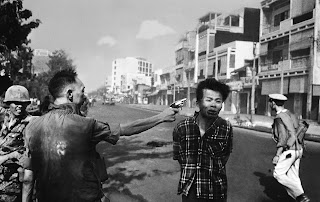
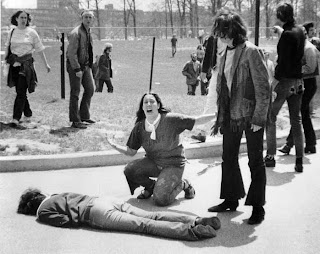
1. Thinking back to World War II, How were American’s reactions to the war different? How was America’s position in Vietnam portrayed on the home front through articles, T.V., photographs as well as any other type of media?
2. How did Herr’s experience as a war correspondent differ from Pyle’s? How is this expressed in the readings? Do Herr’s readings accurately inform the American public?
3. How do Dorthea Lange’s photographs taken during WWII and the Great Depression differ from the famous photographs of the Vietnam war? Do you think the pictures taken during Vietnam accurately depict the feelings of people at home and how people were being treated in Vietnam during this time? ( See below for Pictures)
4. Even though Vietnam was considered a Proxy war, looking back was it? Take into consideration the number of troops, the amount of money spent, the number of bombs dropped, as well as the American publics reaction.
5. How do the attitudes of the soldiers Herr described differ from the soldiers which Pyle interacted with? Do you think the soldiers attitudes had an affect on the outcome of each war? What about the attitude of the American people?
The Vietnam War vs. Civil RIghts for all (Reflection 3)
Today's lecture made me think of how America has the habit neglecting the core issues on the mainland to fight wars in other countries. This was evident with the internment of the Japanese Americans and the lack of civil rights for African Americans during World War II and it is also seen with the Vietnam War and the issues minorities faced in trying to find civil rights. We learned about the different movements shared by the African Americans and Chicanos that occurred during the Vietnam War and it is sad that many of these Americans were sent to fight the Vietnam War when they were not getting the best treatment at home. It is sad that they had to fight for America abroad and also fight for civil liberties at home.
It says something about our nation when a group of people are not seen as equals but they are relied on the most to fight in the war. We learned in lecture that African Americans and Mexican Americans among others were sent to the front lines the most because they lacked high socioeconomic status and did not have any access to college. I would argue that their lack of economic status and access to college also slowed down their progress when it came to civil rights. I do not like that the government allowed certain people who could afford college to stay in America instead of fighting the war in Vietnam because it makes it implies that the minorities who could not afford higher education were disposable; they were not as important to the nation. These ideas lead me to think of our nation in a different way.
It says something about our nation when a group of people are not seen as equals but they are relied on the most to fight in the war. We learned in lecture that African Americans and Mexican Americans among others were sent to the front lines the most because they lacked high socioeconomic status and did not have any access to college. I would argue that their lack of economic status and access to college also slowed down their progress when it came to civil rights. I do not like that the government allowed certain people who could afford college to stay in America instead of fighting the war in Vietnam because it makes it implies that the minorities who could not afford higher education were disposable; they were not as important to the nation. These ideas lead me to think of our nation in a different way.
Subscribe to:
Posts (Atom)